Schengen Zone
The Schengen area is a region of 29 European countries that have abolished their internal borders to allow the free and unrestricted movement of people.
Most EU countries are within the Schengen Area except for Ireland and Cyprus. Additionally, several non-EU counties like Norway, Iceland, Switzerland and Liechtenstein are integral members despite their non-EU status.
Which are the Schengen Area countries?
The 29 Schengen countries are Austria, Bulgaria*, Belgium, Czech Republic, Croatia, Denmark, Estonia, Finland, France, Germany, Greece, Hungary, Iceland, Italy, Latvia, Liechtenstein, Lithuania, Luxembourg, Malta, Netherlands, Norway, Poland, Portugal, Romania*, Slovakia, Slovenia, Spain, Sweden and Switzerland.
*On March 31 2024, Bulgaria and Romania officially joined the Schengen area. This means that Schengen rules, including the issuance of Schengen visas and the elimination of controls at internal air and sea borders, plus land borders, will now be in effect in both countries
Schengen Countries Special Considerations
The following countries are special cases within the Schengen Agreement:
Iceland, Norway, Switzerland and Liechtenstein are associate members of the Schengen Area but are not members of the EU. They are part of the EFTA and implement the Schengen acquis through specific agreements related to the Schengen agreement.
Andorra, Monaco, San Marino and Vatican City have opened their borders but are not members of the visa-free zone.
The Azores, Madeira and the Canary Islands are special members of the EU and part of the Schengen Zone, even though they are located outside the European continent.
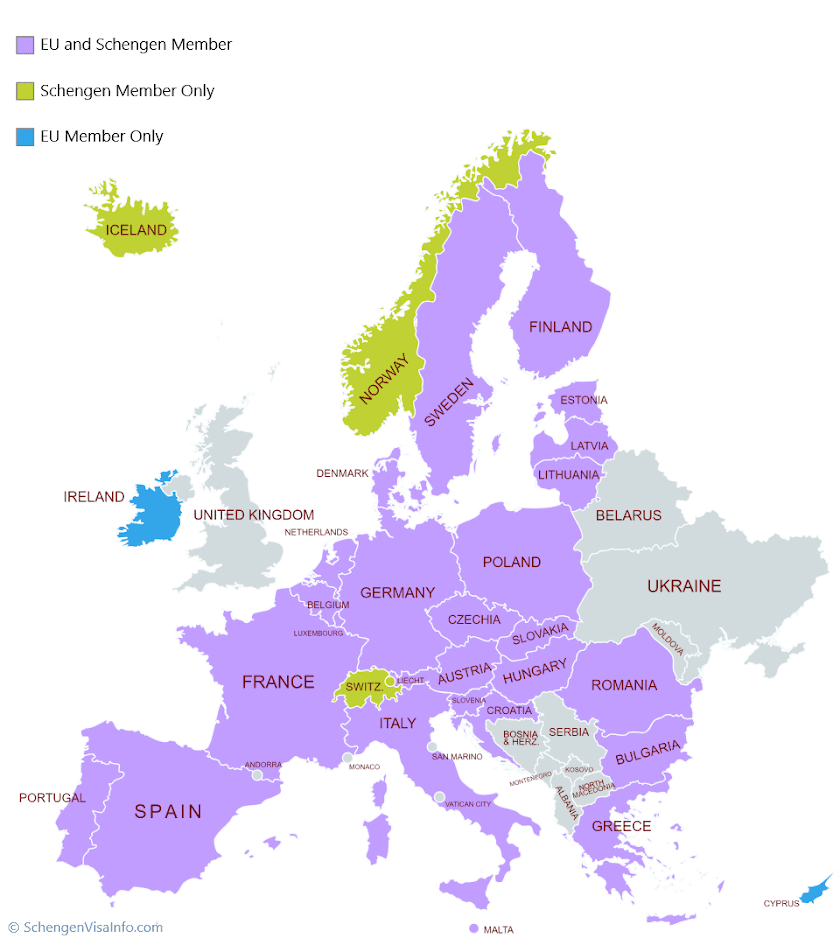
European Countries That Are Not Part of the Schengen Area or the European Union
Armenia, Azerbaijan, Belarus, Bosnia and Herzegovina, Kosovo, Moldova, Montenegro, North Macedonia, Serbia, Turkey, Ukraine and the United Kingdom.
Schengen Zone Rules
If you do not have either a European Union or Schengen zone country passport or a visa to stay in these countries, you cannot spend more than a total of 90 days within a total period of 180 days. Furthermore, once you have used up your quota of 90 days, you cannot return to the Schengen Zone until 90 more days have passed.
Calculating your 90/180 days
Calculating your visa-free days can be complicated. The European Commission provides a calculator to help you track your visa-free days: https://www.visa-calculator.com/
The 180 days aren’t fixed in time. It’s calculated backwards from today.
Your 90 days are calculated from your first day in the Schengen Area within the 180 days.
If you leave and return within 180 days, your last stay will count towards the 90-day maximum.
If you use up your visa-free days, you must leave until you accumulate more days or apply for a visa.
You may be fined or banned from the Schengen Area if you overstay your 90 days.
Example
You arrive in Spain on 18 March. You fly to the UK on 21 April and stay there until the 29th. On 30 April, you travel to Greece and stay there until 23 June. Your trip was 97 days, but only 90 were in the Schengen Area.
You can’t re-enter the Area until at least 14 September, when the Spanish leg of your trip falls outside your 180 days.
If you re-enter on 14 September, you can only stay for another 35 days as your time in Greece still counts towards your current 90 days.
The European Union now electronically monitors all visits to Schengen Zone countries. Because physical passport stamps are no longer issued, it is strongly recommended that you use a Schengen short-stay calculator to track your days and ensure you do not overstay the 90/180-day limit.